
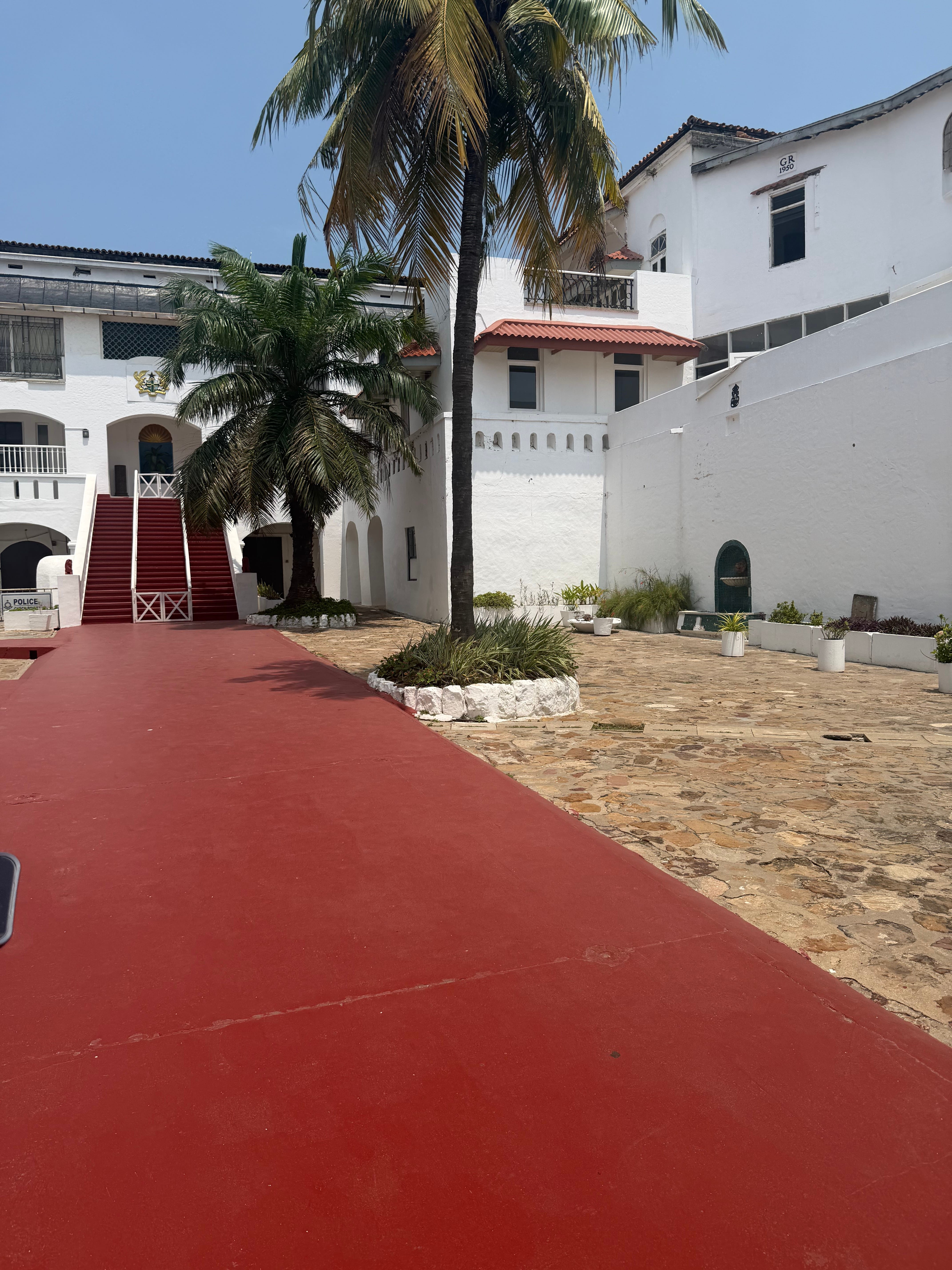
On July 27, 2026, I arrived in Accra, Ghana, with my daughter, spouse, and two other friends who, like me, were celebrating turning fifty. In our Jubilee year, visiting Ghana was the apex of our celebration. After checking into our hotel, we went to visit Osu Castle.
As the van pulled up to the large white castle, we walked through the parking lot to pay our admission and entered.
The young Ghanaian woman who acted as our guide told us that at least 126,000 African people were marketed and sold in the courtyard. She began showing us the various rooms of the castle and explaining how they had been used over time. One room served as a part-time dungeon for enslaved people when it was not filled with brandy. The fact that humans and liquor were seen as interchangeable commodities was infuriating.
Then we arrived in the small female dungeon. Enslaved women and girls were held there with little to no light, ventilation, or means to clean themselves. Our guide explained that many women were packed in this small room and forced to be in this space for long periods of time. With nowhere to relieve themselves or wash, they were living in their own human waste. When they received food, they ate it surrounded by that waste. Although this happened hundreds of years ago, I could still smell traces of the odor they had to withstand daily, reminding me of what they endured. Then our guide showed us how the enslavers built their chapel on top of the female dungeon.
I was speechless.
I could not comprehend how someone could possibly have a worship service upstairs from the cries and stench produced by the cruelty of slavery and remain unbothered.
As I walked out of the room and eventually saw the chapel, all I could think was that this gives an entirely different meaning to “upon this rock, I will build my church.” And, of course, then I had questions.
What does it mean for a church to be built on top of the cries and pain of Black women?
Who is the god they are praising?
What was the preacher preaching?
Then, when I really think about it, I could see this is not simply an aberration from the church’s history. In too many ways, this has been a blueprint for churches. There are many churches built on the work, pain, sacrifice, and cries of Black women. Many churches gather week after week to sing praises to a God while walking by the inhumane treatment of other people with no problem.
How is this possible?
I returned to Matthew 16, where Jesus asks the disciples, “Who do you say that I am?” Simon Peter responds, “The Messiah, Son of the living God,” Jesus calls him blessed and says, “on this rock I will build my ekklesia.”
I know most English translation bibles say, “build my church.” However, ekklesia is the Greek term that is translated as church. The term was initially translated as congregation; it could also be translated as an assembly or gathering of religious, political, or unofficial groups.[1] What is interesting to me is that the term is initially translated as “church” around 1382 in the Wycliffe Bible, but it does not become the dominant rendering until the King James Version in 1611.
Elmina Castle was the first castle built in Ghana in 1482; Cape Coast Castle in 1653; and Osu Castle in 1661. Each of these castles had “churches” either on top of a dungeon or where they had to walk past the dungeons to go to church. According to this timeline, the more normative the word “church” became in the translation, the worse the people were treated in these castles. Again, I grappled with this for quite some time.
Then I began to wonder if they understood ekklesia differently? Could they have acted differently? What if they actually looked at the place that Jesus was wanting to build as a gathering of religious and political groups instead of a place to gather and sing hymns while engaging in crimes against humanity?
I believe Jesus wanted to build a gathering of people to make positive changes in the world, since he said he came to “set the captives free,” not capture the people. What if they followed Jesus instead of only trying to worship him?
It seems to me that Jesus sought change through the ekklesia, and they sought to capitalize through the “church” built on the backs of Black people, particularly women at Osu Castle.
Again, this feels very much like the model for too many “churches” today.
I have seen numerous churches built and sustained through the labor of Black women. Yet, many of these “churches” ignore the pains and cries of the women in their pews and communities. Too often, Black women give themselves away to the point of their own detriment, killing themselves in churches that will celebrate killing them at their funeral but will not help them while they are living.
So, I also wonder whether we would act differently if we understood ekklesia differently?
Would Black women understand their relationship to the church differently if we stopped teaching that faithfulness requires sacrificing ourselves for institutions that refuse to care for us?
Would congregations understand themselves differently if church were not primarily somewhere we go, but a people gathered to participate in God’s liberating work?
I will never forget the holes in these dungeons where they dropped food to the enslaved people. I will never forget looking through that hole and seeing the church. I will never forget the hell they allowed my ancestors to live in while they sang their hymns.
As we wrapped up the tour, I was angry. I was hurt. I looked out at the ocean as the waves continued to come in strong.
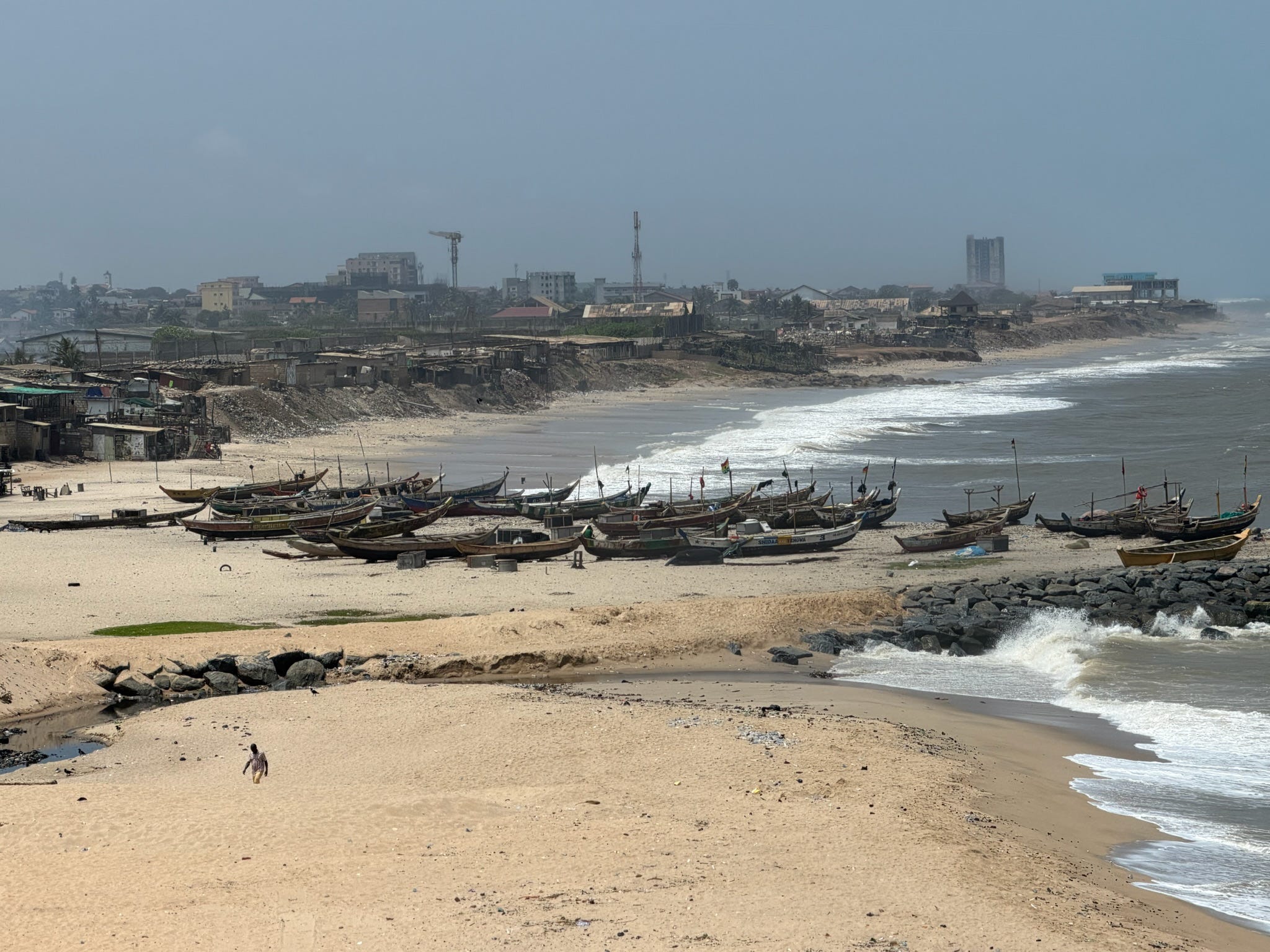
And in that moment, I remembered something else.
They built their dungeons.
They built their castles.
They built their “church” above the cries of our ancestors.
They attempted to commodify, dehumanize, and destroy us.
But they did not have the final word.
Not even their “church” could stop my ancestors.
Because here I stand.
[1] Newman Greek Dictionary
Love this! Keep on keeping on, Rev!
What a vivid reflection! I could see what you were saying. You give us much to consider as we too grapple with the difference between “church” and the ekklesia built by Jesus.